Wednesday, August 29, 2018

New York Times piece on '68 Democratic Convention Protest


‘The Whole World Is Watching’: The 1968 Democratic Convention, 50 Years Later

On Aug. 28, 1968, violent clashes in Chicago between demonstrators and the police produced one of the most polarizing showdowns of the 1960s. People are still debating what it all meant.

Tuesday, January 31, 2017

Hitting Left: The Klonsky Brothers on Lumpen Radio in Chicago


Tune in every Friday at 11 a.m. (CDT) for the Klonsky Bros. Hitting Left, live on Lumpen Radio. 
The show is also available on MixCloud and via podcast.

Friday, June 03, 2016

My webinar with Jonathan Kozol


Mr. Kozol has not lost his passion for progressive education in America, On our June 1st  SOS Webinar, Mr. Kozol will discuss topics he has devoted his life to, including the damage done to children by testing mania, the damage done to teachers by a regiment of punitive accountability built on test scores, and the shameful inequality between rich schools and poor, the latter resulting in the near total segregation within our schools. For Black and Hispanic children, separate and unequal education is an everyday phenomenon.
A portion of the virtual fundraiser tied to Mr. Kozol's SOS Webinar will go to scholarships for the students he's been working for all his life: those in need, and those who want to be part of the solution....to change an education system that fosters segregation and inequality while actively ignoring if not crushing creativity, curiosity and originality, as critical capacities of children.
Please click here to make a generous  donation to the   SOS Convention fund. 
We suggest a $25 contribution, but any and all amounts will be gratefully appreciated! 
Save Our Schools Coalition Webinar and Fundraiser 
Moderated by Mike Klonsky 
Wednesday, June 1st, 8 PM [EDT] 
https://attendee.gotowebinar.com/register/7245044229553562114 

Wednesday, September 30, 2015

A brief appearance in the Black Panther documentary

1969 press conference: From left: Fred Hampton and Bobby Rush (Black Panthers); Cha Cha Jiminez (Young Lords Organization); Mike Klonsky (SDS)
I have a small part in Stanley Nelson's new documentary "The Black Panthers: Vanguard of the Revolution." I am also doing post-performance Q&As at several of the showings.
Nelson goes on to chronicle many of the Black Panthers’ achievements, such as their trailblazing breakfast program for children, and the indisputable effect of the party to inspire pride in black Americans, and respect from the radical Left. As Mike Klonsky of the Students for a Democratic Society remarks, the Black Panthers were viewed as “the vanguard of the revolution.” -- Film Journal International 

Wednesday, September 10, 2014

AT KENYON COLLEGE


Spoke in this class of undergrads at Kenyon College, Monday evening. They are reading Jonathan Kozol's "Savage Inequalities". After class,  students and their great prof, Peter Rutkoff, posed for this group pic to send to Jonathan as a birthday greeting.

I'VE BECOME A REGULAR ON THE PATTI VASQUEZ SHOW ON WGN


Friday, March 28, 2014

ON RAG RADIO IN AUSTIN TEXAS WITH PROF. JULIAN VASQUEZ HEILIG

Rag Radio: Fighting for Public Education with Julian Vasquez Heilig & Mike Klonsky (February 28, 2014)


Julian Vasquez Heilig and Mike Klonsky join Thorne Dreyer in discussing our endangered public education system, the nature and genesis of the flawed "educational reform" movement, and ideas about how public schools can be improved and can be saved from privatization.

Vasquez Heilig hosted the Network for Public Education's first National Conference, held March 1- 2, 2014, on the campus of the University of Texas at Austin. Mike Klonsky moderated a panel on "Movement Building" at the gathering of leading public education activists. The group was founded by noted author and educational policy analyst Diane Ravitch in 2013, and has become a prominent voice in the education reform debate.

Tuesday, August 20, 2013

On Rag Radio in Austin, TX -- Aug. 20, 2013

RAG RADIO / Thorne Dreyer : Chicago’s Mike Klonsky Fights for Public Education, ‘Small Schools’

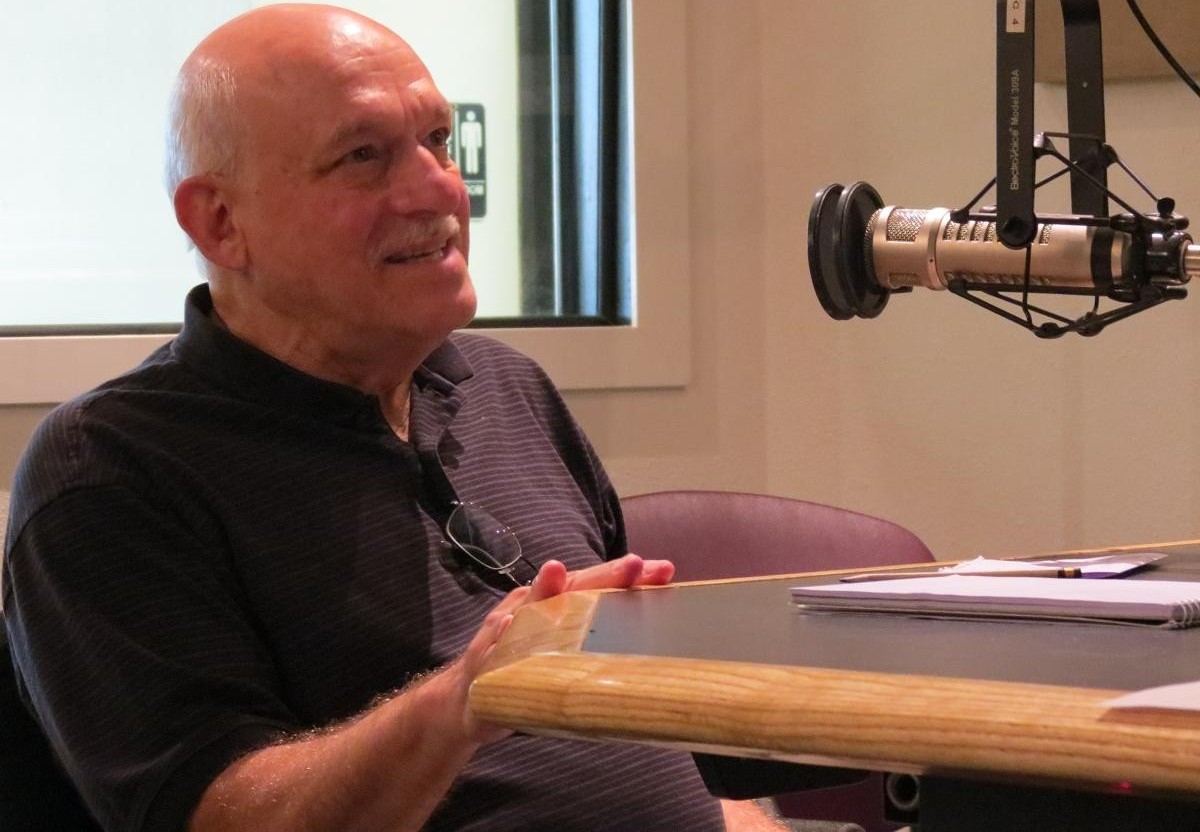
Chicago education activist Mike Klonsky in the studios of KOOP Radio, Austin, Texas, Friday, August 20, 2013. Photo by Roger Baker / The Rag Blog.

Rag Radio podcast:
Former SDS leader Mike Klonsky is fighter
for ‘Small Schools’ and democratic education

A veteran of the Civil Rights Movement and the struggle against the War in Vietnam, Mike has been involved in community and labor organizing as well as the fight for democratic education.

By Rag Radio | The Rag Blog | September 4, 2013
Former SDS leader Mike Klonsky, now a Chicago-based public education activist and advocate for “Small Schools,” joined us on Rag Radio, Friday, August 30, 2013.

Rag Radio is a weekly syndicated radio program produced and hosted by long-time alternative journalist Thorne Dreyer, and recorded at the studios of KOOP 91.7-FM, a cooperatively-run all-volunteer community radio station in Austin, Texas.
A veteran of the Civil Rights Movement and the struggle against the War in Vietnam, Klonsky was a leader in Students for a Democratic Society (SDS), serving as SDS National Secretary in 1968, and has been involved in community and labor organizing as well as the fight for democratic education. A “red diaper baby,” his father was a life-long activist and a veteran of the Spanish Civil War.
Mike Klonsky teaches in the College of Education at DePaul University. One of the founders of the Small Schools Workshop, Mike serves as its national director. He also coaches basketball at a Chicago high school. Klonsky is the author of Small Schools: The Numbers Tell a Story (University of Illinois Small Schools Workshop) and co-author, along with Bill Ayers and Gabe Lyon, of A Simple Justice: The Challenge for Teachers in Small Schools (Teachers College Press).
Mike Klonsky on Rag Radio. Photo by Roger Baker / The Rag Blog.
Mike served as a member of the National Advisory Council on Youth Violence and is past president of the editorial board of Catalyst, Chicago’s school-reform journal. He has also written extensively on the history and progress of Chicago’s dynamic struggles to save and transform public schools. His SmallTalk Blog is read by thousands of educators and activists.
Read Mike Klonsky’s August 27, 2013, article, “Drive-By Teachers and the Great Charter School Scam,” on The Rag Blog.

Thursday, June 27, 2013

All Male Youth Summit, Calumet City, IL


On Monday, March 25, 2013 we had over 500 male students from third through eighth grade and well over 20 presenters from various professions attend this phenomenal event.
Distinguished Presenters

Dr. Michael Klonsky, DePaul University Professor & Educational Consultant
Marc Augustave, Assistant Corporate Counsel
Don Murphy, American Family Insurance
Honorable Judge Orville E. Hambright,Jr., Circuit Court
Honorable Judge William Boyd, Circuit Court
Dr. James Cunneen, Retired Superintendent & Educational Consultant
Chief Mark Davis, Chief of Police Calumet Park, IL &Retired Chicago Police Commander 32 years
Gerald Jones, Educator at Rich Township District 227 & Chairman and Coordinator of the Guide Right Program for Kappa Alpha Psi Fraternity, Inc., Evergreen Park, Illinois
Percy Colvin, Entrepreneur Colvin Printing and Graphics
Honorable State Representative William Davis, 29th District
Frank Dixon, CTA and Minister, New Evangelical Bible Church
Dr. Ron Garner, Architect
Terrence Lyles, Insurance Consultant for American Family
Khomeini Khan, AXA Equitable Financial
Anthony Brown, AXA Equitable Financial
Pastor Dr. Michael Reynolds, New Life Celebration
Michael Rogers, Architect for McDonald’s Corporation
Oscar Scott, College Recruiter
Michael Steele, Educational Administration
Honorable State Representative Thaddeus Jones, 27th District
Dr. Johnny Thomas, Superintendent District 155 Crystal Lake, IL
Dr. Creg Williams, Superintendent District 215 Calumet City, IL
John Ross, Lieutenant for Chicago Fire Department
Elmer Winters, Staff Sergeant for U.S. Army
Joseph Jemison Jr., Comedian and Actor
Richard Wills, Cook County Probation Officer

Friday, September 21, 2012

WTTW, Chicago Tonight, September 10, 2012


SENATE BILL 7
Springfield passed ambitious education reform last year, intending to transform the system and make it harder for unions to strike. One year later, what’s changed? How did Chicago end up with a historic strike on its hands?

http://chicagotonight.wttw.com/2012/09/10/attempts-education-reform-illinois

Monday, April 30, 2012

From pineapples to small schools, alum Mike Klonsky's work is no small talk

From UIC Alumni Magazine, UIC College of Education

April 30, 2012

Professor Michael Klonsky teaches in the College of Education at DePaul University in Chicago. He also serves as the national director of the Small Schools Workshop, and on the national steering committee of Save Our Schools, a national movement dedicated to supporting public schools. Klonsky has blogged, spoken and written extensively on school reform issues with a focus on urban school restructuring. Klonsky received his MA in Education Studies in 1992 and his PhD in Curriculum & Instruction from UIC in 1996. He talks with Communications Director Eva Moon.

Can you talk about how your UIC education laid the groundwork for your future work?

The college, under both of our deans, Larry Braskamp and then Vicki Chou, was a wonderful place to learn and develop as an educator. My personal interaction with some of the leading lights in the curriculum field exposed me to a broad range of theoretical and practical approaches to public education. It was Dr. [William] Schubert who first and most creatively raised these three fundamental questions to his graduate students: "What knowledge is most worthwhile? Why is it worthwhile? And how is it acquired or created?"

Can you tell me how you got your start on the small schools road?

The early school reform movement engaged hundreds of mostly young teachers in transformation efforts within their own schools. Many began approaching those of us within the COE who had been influenced by educators like Deborah Meier and Michelle Fine, who were small schools pioneers in New York and Philadelphia. Among the most influential scholars and prolific writers on small and alternative schools was the late, Mary Anne Raywid who became a mentor to me.

In 1991, Professors Bill Ayers and the late Bruce McPherson created the Small Schools Workshop, and they invited me to become involved in this project that was focused on the ideas of democratic education, personalization, reflective teaching practices, and professional community. My dissertation documented our collaborative work with hundreds of Chicago Public School teachers and principals engaged in transforming large, traditional high schools into smaller learning communities.

What is the current state of the small schools movement?

Susan Klonsky [his wife] and I wrote a book in 2007, Small Schools: Public School Reform Meets the Ownership Society, whose title pretty well sums up the status of the current small-schools movement and the co-opting of the language of school reform by business-type school reformers. While there are still dozens of wonderful, teacher-led, public small schools around, most have been swallowed up in the drive toward privatization and over-emphasis on standardization and testing.

Tell me about your blog. How widely is it read? What is the impact of the issues you raise and the subsequent discussion?

I have been blogging for nearly a decade on my SmallTalk blog, and am also active on Twitter. My blog gets about 30,000 hits a month and I have close to 3,000 followers on Twitter – not nearly as many as Lady Gaga's 7 million, but enough to make it worthwhile for me. I usually blog early in the morning, while I am reading through the daily media. I write about things that catch my attention, like the recent mass turnover of Philadelphia's public schools to private management groups, or the crazy standardized test questions in New York around Daniel Pinkwater's children's story, The Hare and the Pineapple. Bloggers and tweeters played a big role in that story going viral, and in forcing some inane test questions to be pulled from the tests.

As you reflect on your time at UIC, what lasting impressions do you have?

I still look back on my days in the College of Ed with great fondness. The COE faculty instilled within me a love of learning and of teaching that I still embrace. Even though I'm semi-retired, I still enjoy my life as an educator, now teaching graduate students Philosophy and Sociology of Education at DePaul.

Sunday, March 25, 2012

Keynoter at Bowling Green

The third annual Urban Education Conference is where BGSU undergraduates presented  alongside University faculty, graduate students, professional teachers, and administrators to learn from each other about the complexities of the urban education experience.

The Keynote speaker was Dr. Michael Klonsky, Small Schools Workshop, Chicago,  "Public Schools-An Endangered Species" at 6:30 p.m. on Friday, March 23, in 101 Olscamp Hall.

Friday, May 06, 2011

From Huffington Post

Mike Klonsky: Chicago Schools CEO Choice Shows Problem With Mayoral Control

"He received a resolution of no-confidence from the Community Education Task Force and a 94.6 percent vote of no confidence from Rochester Teachers. That speaks for itself.'' "In introducing Jean-Claude Brizard this week as his Chicago schools chief,... Full Article at Huffington Post

Monday, February 21, 2011

Mike Klonsky interviewed about Chicago's new mayor

This extensive interview I did with on Labor Express begins here at 28.30 and runs until the end of the show.


[audio]Labor Express For 2-21-11 - Jerry Mead-Lucero

This is the full 2-21-11 episode of the Labor Express Radio program. The past week has been one of those weeks in which I wished Labor Express aired 2 or 3 times every week. There is no way we can do justice on today’s program to all the important developments of the past week. Of course tomorrow is election day in Chicago and, as promised I will bring you my interview with Mike Klonsky on Rahm Emmanuel’s policy positions on public education...

Friday, October 29, 2010

New book takes critical look at the Gates Foundation

The Gates Foundation and the Future of 
US “Public” Schools 

Edited by Philip E. Kovacs
Price: $95.00
Binding/Format: Hardback
ISBN: 978-0-415-87334-5
Publish Date: October 21st 2010
Imprint: Routledge
Pages: 232 pages

A critical look at the Bill and Melinda Gates Foundation that  includes a chapter by Michael Klonsky, "Power Philanthropy: Taking the Public Out of Public Education."

Foreword Deron Boyles. Acknowledgments. 1. From Carnegie to Gates: The Bill and Melinda Gates Foundation and the Venture Philanthropy Agenda for Public Education Kenneth J. Saltman 2. Power Philanthropy: Taking the Public Out of Public Education Michael Klonsky 3. The Gates Foundation’s Interventions into Education, Health, and Food Policies: Technology, Power, and the Privatization of Political Problems David Hursh 4. Marketing New Schools for a New Century: An Examination of Neoliberal School Reform in New York City Jessica Shiller 5. Corporatism, KIPP, and Cultural Eugenics Jim Horn 6. Disabusing Small-Schools Reformism: An Alternative Outlook on Scaling Up and Down Aimee Howley and Craig B. Howley 7. Governing Identity Through Neoliberal Education Initiatives: "Get[ting] Schooled" in the Marketplace Leslee Grey 8. The Gates’ Foundation and the Future of U.S. Public Education: A Call for Scholars to Counter Misinformation Campaigns Philip E. Kovacs and H.K. Christie 9. The Giving Business: Venture Philanthropy and the NewSchools Venture Fund Jim Horn and Ken Libby 10. Dear Bill: "Grokking’ Education Patti Lather 11. An Open Letter to Bill Gates, Jr. (With a Message to My Colleagues) David Gabbard 12. Why Current Education Reform Efforts Will Fail Marion Brady
There has been much public praise for the Bill and Melinda Gates Foundation’s efforts to reform public education. However, few scholars have engaged substantively and critically with the organization’s work. While the Gates Foundation is the single largest supporter by far of "choice" initiatives particularly with regard to charter school formation, it is pushing public school privatization through a wide array of initiatives and in conjunction with a number of other foundations. What are the implications for a public system as control over educational policy and priority is concentrated under one of the richest people on the planet in ways that foster de-unionization and teacher de-skilling while homogenizing school models and curriculum? The Gates Foundation and the Future of U.S. "Public" Schools addresses this crucial, unanswered question while investigating the relationships between the Gates Foundation and other think tanks, government, and corporate institutions.

Wednesday, July 07, 2010

Reviewed in "Improving Schools"

Michael and Susan Klonsky (2008) Small Schools: Public School Reform Meets the Ownership Society
Routledge ISBN 0 415 96123 8 £14.99 208 pages

Mark Berends, Matthew Springer and Herbert Walberg, eds (2008)
Charter School Outcomes Lawrence Erlbaum ISBN 0 8058 6222 6 £21.99 300 pages

Reviewed by Terry Wrigley, University of Edinburgh

One of the key differences between secondary education in the UK and USA concerns school size. Across Britain, the common assumption is that secondary schools below about 800 students aren’t really viable. The average secondary school size in England grew from 820 to 1000 between 1992 and 2002 (Newman et al., 2006), though at the end of this period 29 per cent of secondary schools still had fewer than 800. There has been little policy interest in small schools, though small size is often used as the pretext for closure and (increasingly) privatization. Ironically, those who make this argument seem unaware that in PISA-prizewinning Finland there are few secondary schools with more than 500 students, and half are below 300.

The few UK-based research studies point to some attainment disadvantages of smaller but also of larger than average schools, but this is slight and sometimes incestuous in its citation. Spielhofer et al. (2002) in their empirical study acknowledge that this may be due to the quasi-market system of English schools, especially in urban areas, which seems plausible: the publication of league tables and their impact on parental choice
systematically leads towards school rolls declining in schools that have lower attainment than their neighbours, even if this is caused by socio-economic factors. Thus, it is probably relatively lower attainment which leads to smaller schools rather than the reverse.

This is in contrast to the many US-based studies that associate smaller size with higher attainment, particularly for poorer and ethnic minority students, and that point to an improved ethos and social development for all kinds of students in smaller schools. There are clear parallels to school-within-school or year-group structures in (already quite small) Norwegian and Swedish schools.

The USA has seen a remarkable movement towards small schools. Some of these replace existing schools, while others are the result of restructuring large high schools to make several schools-within-schools. It is surprising that England’s policy-makers, who have borrowed so much from the USA, have such little interest in the small-school movement.

For an outsider it is difficult to disentangle the question of small schools from the Charter School reform, and there is substantial overlap. In brief, Charter Schools are publicly funded but privately managed schools. There are already 4000 in 40 states, with heavy concentrations in some politically conservative areas and states. Many are small but others aren’t. They vary from community-run schools with progressive teaching teams and curricula to chains of schools run by edu-businesses. It is important for English educators to understand this, since they seem identical to England’s City Academies, which are also publicly funded but privately run. This controversial programme has hit many obstacles and much resistance. Significantly, the English government set a price tag on these by requiring academy ‘sponsors’ (i.e. the private management) to contribute £2,000,000, thus precluding more progressive community based initiatives.

Michael and Susan Klonsky’s book helps enormously in understanding the relationship between the small school reform and Charter Schools. They present a revealing account of ‘two trains running’, the drive towards smaller secondary schools on the one hand, and a business takeover of schooling on the other. They are committed advocates of small schools, tracing the origins of this movement to the Freedom Schools and Citizenship Schools of the 1960s civil rights campaign. They see them as a re-invention of Deweyan progressivism in the Information Age. They emphasize the need for community among students and closer student–teacher relationships, as well as the professional learning community of staff. Staff were empowered to rethink education and respond to the challenge of ‘savage inequalities’ (Kozol, 1991). There is currently
enormous diversity of small schools, often as small as 200 or 300, supported by such networks as the Coalition of Essential Schools.

The drive towards small schools has attracted extensive support, from the libertarian left to big city councils and global businesses. Though some of the business support has been benign and hands-off, the Klonskys describe an accelerating process of privatization, in terms of both control and a redirection of educational aims. The Klonskys tell a powerful story of the corporate takeover of public schooling, involving some of the world’s biggest corporations. These include the gigantic Wal-Mart, through its Walton Foundation. The earlier progressive orientation has been undermined by the Neo-Cons, though often sheltering behind a pseudo-progressive rhetoric. Thus the KIPP (Knowledge is Power Program) schools, sponsored byWalton,
are singled out as an example of ‘the most mind-numbing and cultish’ charter schools. Particularly widespread in low-income neighbourhoods, such schools seem bent on disciplining and exhorting the poor rather than developing human potential (much likeWal-Mart as a workplace with its relentless company cheers and deadend jobs). (Liza Featherstone, writing in The Nation, quoted on page 110)

The authors also raise questions about a recent change in direction of the Gates charitable foundation, which originally gave hands-off support to a range of models of small school and schools-within-schools, but appears now to be committed to the closure and replacement (privatization) rather than restructuring of existing schools. Good examples are given of supposedly not-for-profit organizations sub-contracting
schools to for-profit management companies to overcome the terms of the charter. Many of the Charter Schools, far from empowering staff, have forbidden union organization.

The school reform has simultaneously been distorted and undermined by the so-called No Child Left Behind policy. Under duress from the NCLB, the district (Chicago) pulled the rug out from under this first wave of school reform, and all traditional schools were put on a strict testprep regimen. Across the city, principals were told to discontinue small-schools initiatives and to focus instead on test preparation. However, the small-
movement had gone too far and attracted too much investment and popular support to turn back… Surviving small schools were pressured to give up many of their innovations and conform to standardized, and even scripted, modes of instruction and assessment. (pages 39–40)

The situation is also complicated because some city councils are strongly backing small school reforms in order to retain schools within the public sector and keep Corporate America at bay. There have been contradictions between city bureaucracies and the dynamics of small-school foundation. The book includes a case study of a large high school whose staff were simply informed by letter that their school was to be broken up into smaller schools, causing massive resentment and the failure of the restructuring. The Klonskys call for a return to the original aims and direction of small-school reform. They remind us that the reform was never just about size, but was about rethinking the nature of education and strengthening professional initiative and control. According to Professor Michelle Fine of City University New York, many of the new small schools have become ‘big schools in drag’.

All too many small schools have the same authoritarian principals, disempowered and uninspired educators, dubious high-stakes tests, and Eurocentric curricula as the large schools they were designed to replace. (Fine, quoted on page 92) The other book reviewed here (Berends et al.) is a less exciting read but important in
its own way. It examines some of the claims that Charter Schools are more successful than public schools, and advises caution. The earlier chapters consider carefully the flaws in some school effectiveness research which doesn’t take important factors into account. For example, it looks at the various reasons why pupils may be transferred by their parents to a Charter School, leading to differences in prior attainment or progress,
and involving different degrees of parental and pupil engagement. It also reviews quantitative research on a range of issues such as engagement, personnel policy, wage setting and management.

The case studies in the final section focus on areas with high concentrations of Charter Schools, and conclude that overall the experiment has not succeeded. They also show that they have tended to lead to greater racial segregation. For example:
Our results from California show that charter schools generally perform on par with or slightly below the achievement levels of traditional public schools, they have not closed the achievement gaps for minorities, and they have not had the expected competitive effects on traditional public schools. (page 190)

* * *
It is useful to read these books in conjunction with Small Schools and Urban Youth (Conchas and Rodriguez, 2008), which illustrates some of the tensions and differences between school ‘designs’. Their book, based on three case studies, shows how internal divisions can, in the worse cases, lead to inequality rather than overcoming it (for example, when one ‘academy’ or internal division has higher status and requires good
skills levels for admission). This book, like the earlier High Schools on a Human Scale (Toch, 2003), also contains many inspiring accounts of innovative and successful small schools.

Book Reviews 281 Improving Schools
Downloaded from imp.sagepub.com by guest on July 7, 2010
References